 PrimeMap
J N D, 29-6-1856: Who Was the Girl Beneath the Forest Cross?
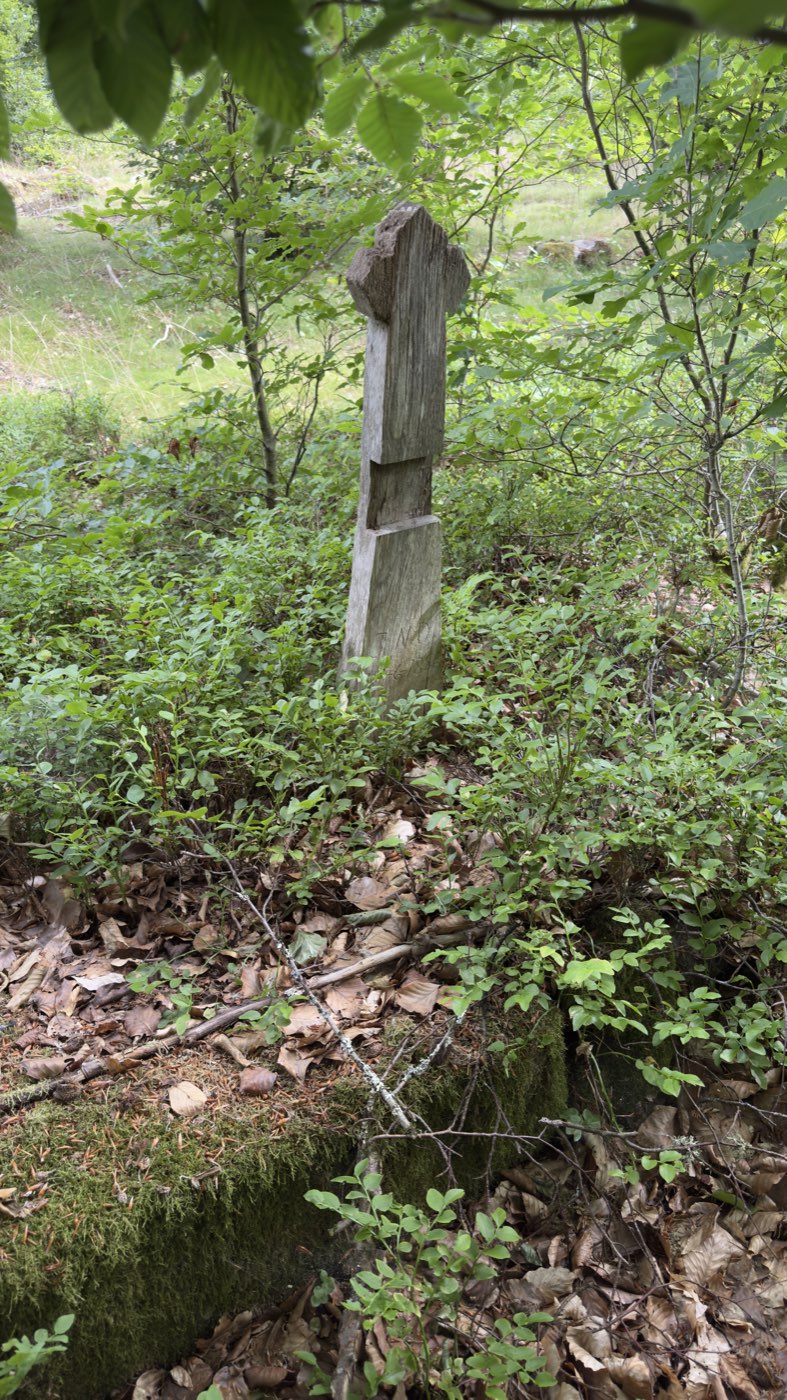
In the woods near Hästveda in northern Skåne stands a wooden cross, not quite knee-high. It carries three letters and a date — nothing else. No name, no sentence, no explanation. The Swedish heritage register has known this cross for decades and describes it down to the centimetre. About the person it stands for, it says five words. I wanted to know who that was.
A pin on the map
I didn't find this cross while out hiking. I saw it on the map — a pin in the forest, far from any road, with no car park and no signpost. Exactly the kind of entry I built the app for in the first place: the Swedish heritage register knows tens of thousands of such spots, but none of them are signposted. You have to know they are there.
So I drove out. A stretch of forest track, then straight through the stand of trees, and suddenly there it is: a narrow wooden cross on a flat stone foundation, grey and cracked, covered in lichen.
Three letters and a date
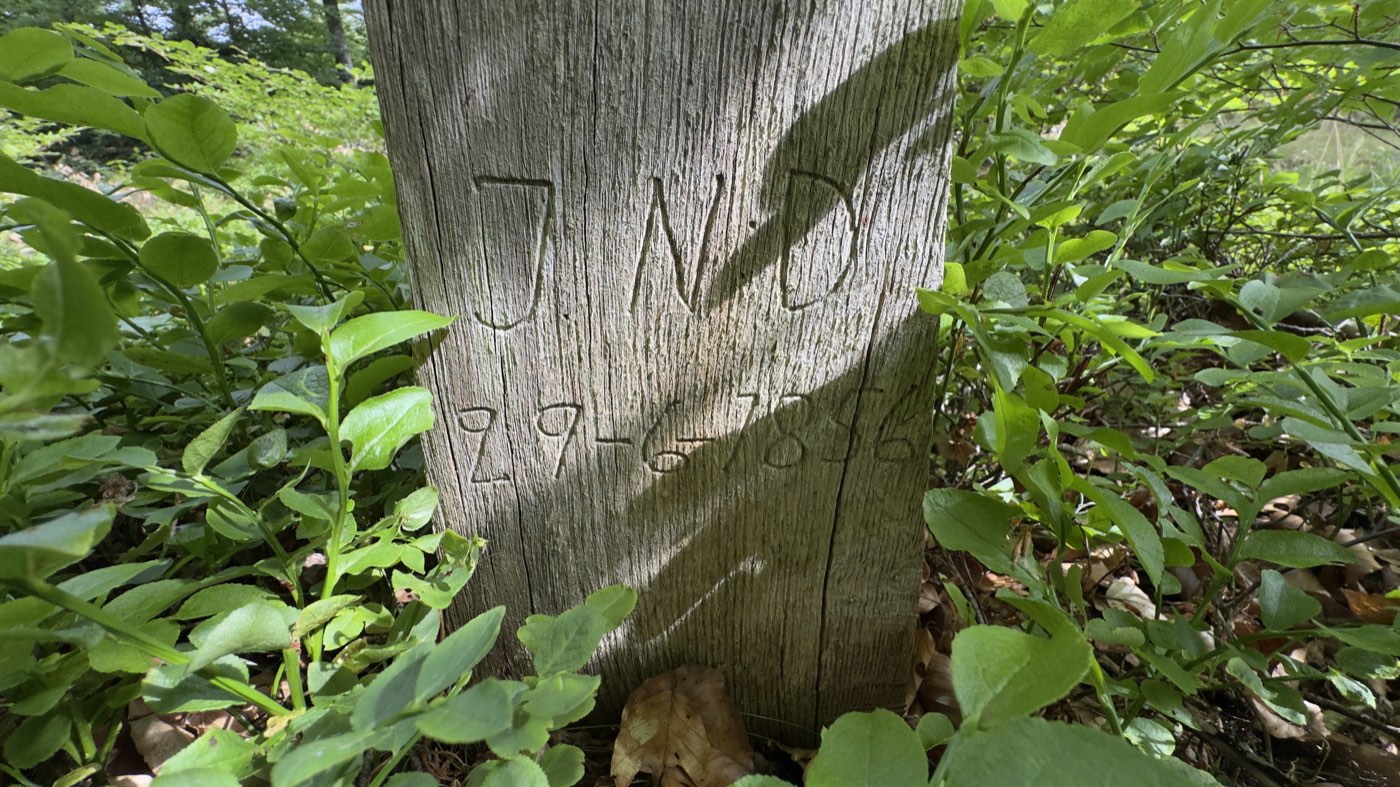
The letters were cut into the wood with a knife or chisel, deep enough to outlast more than one human life. Below them, slightly crooked and unpractised: 29-6-1856.
The heritage register describes the site soberly and precisely. A minneskors — memorial cross — of wood, 0.8 metres high, the cross arms 0.6 metres long, on a stone foundation measuring 1.8 by 1.3 metres. The inscription is recorded there as I.N:D. 29.6.1856; in older Swedish spelling the carved J and an I are the same letter. And then the one sentence that leaves everything open:
"The cross was raised in memory of a young girl who was killed on this spot by a falling thick tree branch."
A young girl. No name, no age, no origin. Plus a marginal note: the old cross was replaced by the present one in 1973, and remains of the old one are said to still lie on the site. I didn't look for them — I will next time.
The sign that no longer says anything
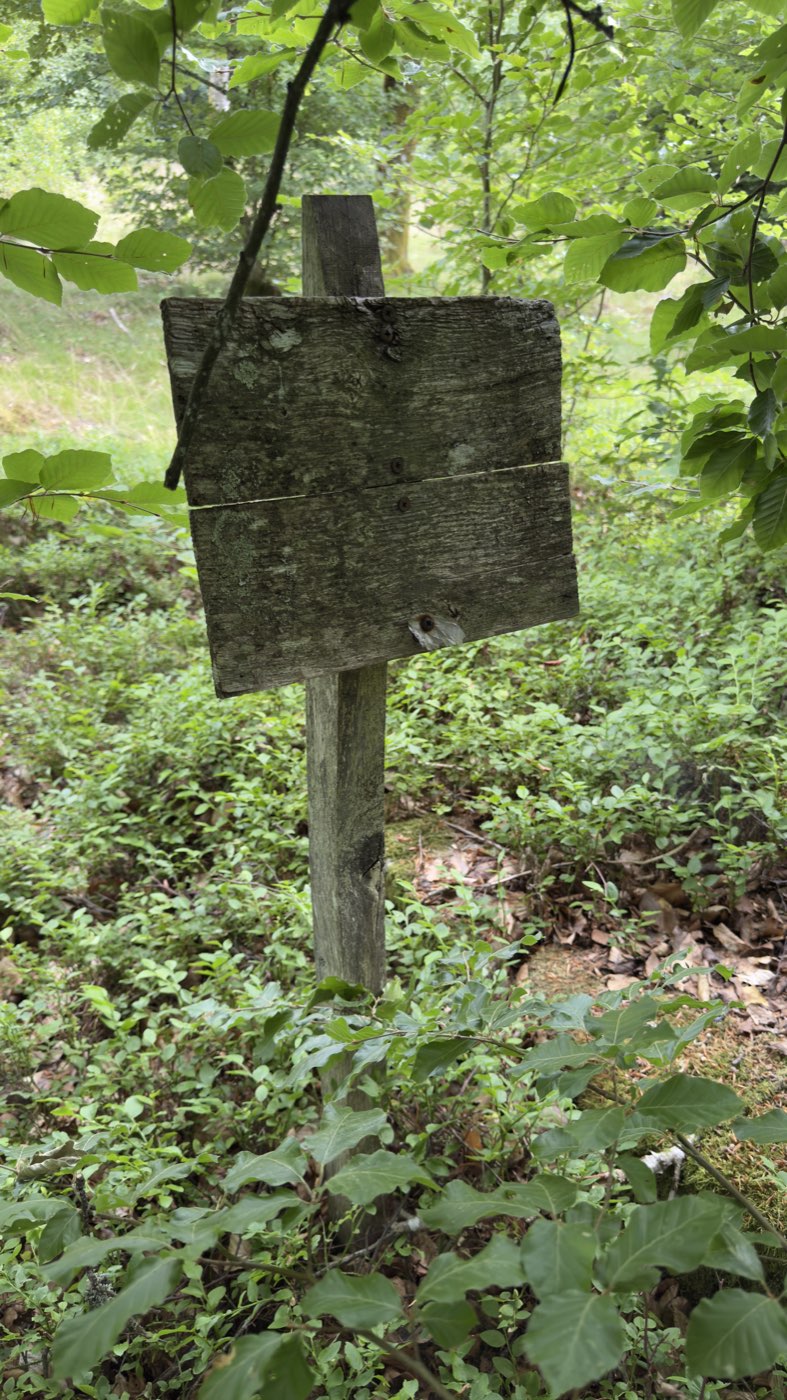
A few steps away stands a post with a wooden board. At some point it must have said what happened here. Now the board is silver-grey, speckled with lichen, and the writing is gone without a trace. You can see the grain of the wood, nothing more.
This is the point where the story ends for most visitors. A cross without a name, a sign without text, a date from the 19th century. For me it started here.
Into the parish register
I had one advantage: I knew the date of death. Anyone who died on a particular day in a particular area appears in exactly one book — the burial register of the responsible parish. Here that was the church of Hästveda, and its books are digitised at the Swedish National Archives.
So that evening I opened the death register for 1856 and worked through the entries until 29 June came up. It didn't take long.
Johanna
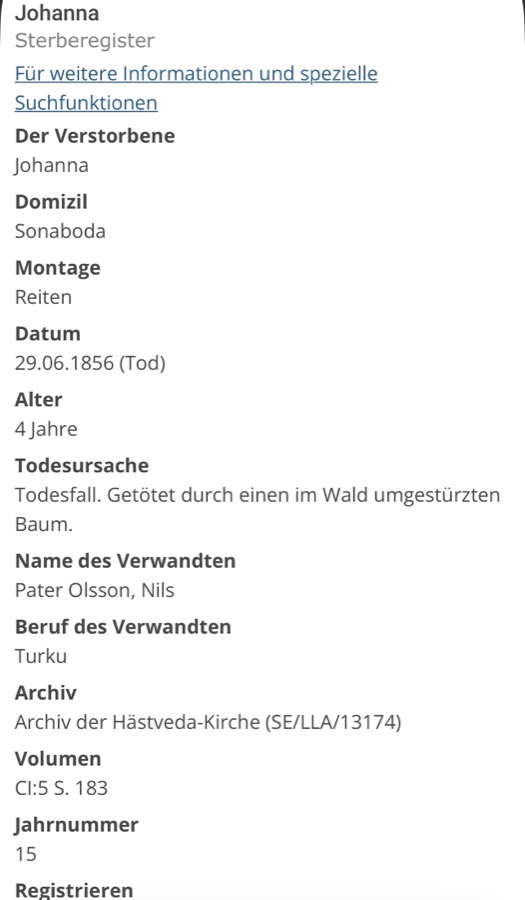
There she is. Johanna. Resident at Sonaboda. Died 29 June 1856. Age: four years.
And in the column for cause of death, where you normally read consumption or old age, a sentence that makes you sit back: killed by a tree that fell over in the forest.
Her next of kin is entered as her father: Nils Olsson, by trade a torpare — a crofter, a smallholder farming rented land, the bottom rung of the rural ladder. No property of his own, a cottage, a patch of field, hard work.
With that, the cross had a name. But I also wanted the beginning.
The beginning, four years earlier
The same parish archive, a different book: the baptism register. And there she appears again.
Johanna was born on 12 April 1852. Father: Nils Olsson, crofter at Sonaboda. Mother: Sissa Trulsdotter, 41 years old when Johanna was born. The neighbours stood as witnesses at the baptism: Pehr Johnsson of Stenkeslycke, Nils Bengtsson of Eskeberga, Elna Truedsdotter of Benarp and Kerstin Torkelsdotter of Sonaboda.
Between 12 April 1852 and 29 June 1856 lie four years, two months and 17 days. That is the whole life.
J N D
And that also resolves the three letters. Sweden had no fixed family names back then, but patronymics: the son of Nils was Nilsson, the daughter of Nils was Nilsdotter.
J N D — Johanna Nilsdotter.
Whoever carved the cross did not spell the name out. He had no need to. Everyone in the district knew at the time who was meant.
Why was she even there?
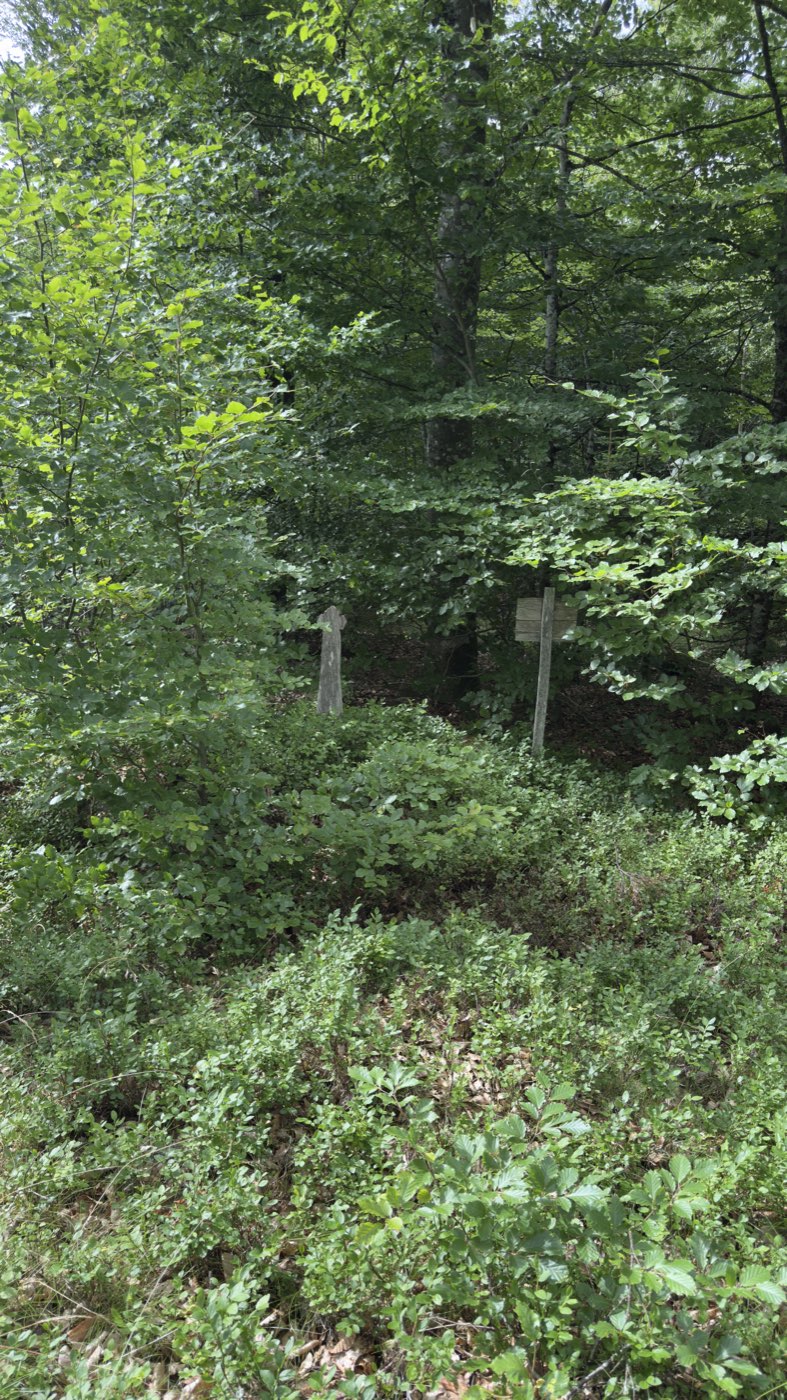
That is the question the books do not answer — and it has stayed with me since. Sonaboda is not a village. It is a name for a handful of farms scattered across the landscape, and it lies several kilometres from the spot where the cross stands.
A four-year-old child, kilometres from home, in the forest. My guess — and it is no more than a guess — is that she was on her way from one farm to another, as country children constantly were back then. Journeys nobody makes any more were everyday life: to the neighbour, to the mill, out to the cattle.
What exactly happened is told slightly differently by the two sources. The parish register speaks of a tree that fell over, the heritage register of a falling thick branch. In the end the difference does not matter. A child walked through the forest, and the forest killed her.
The place around it
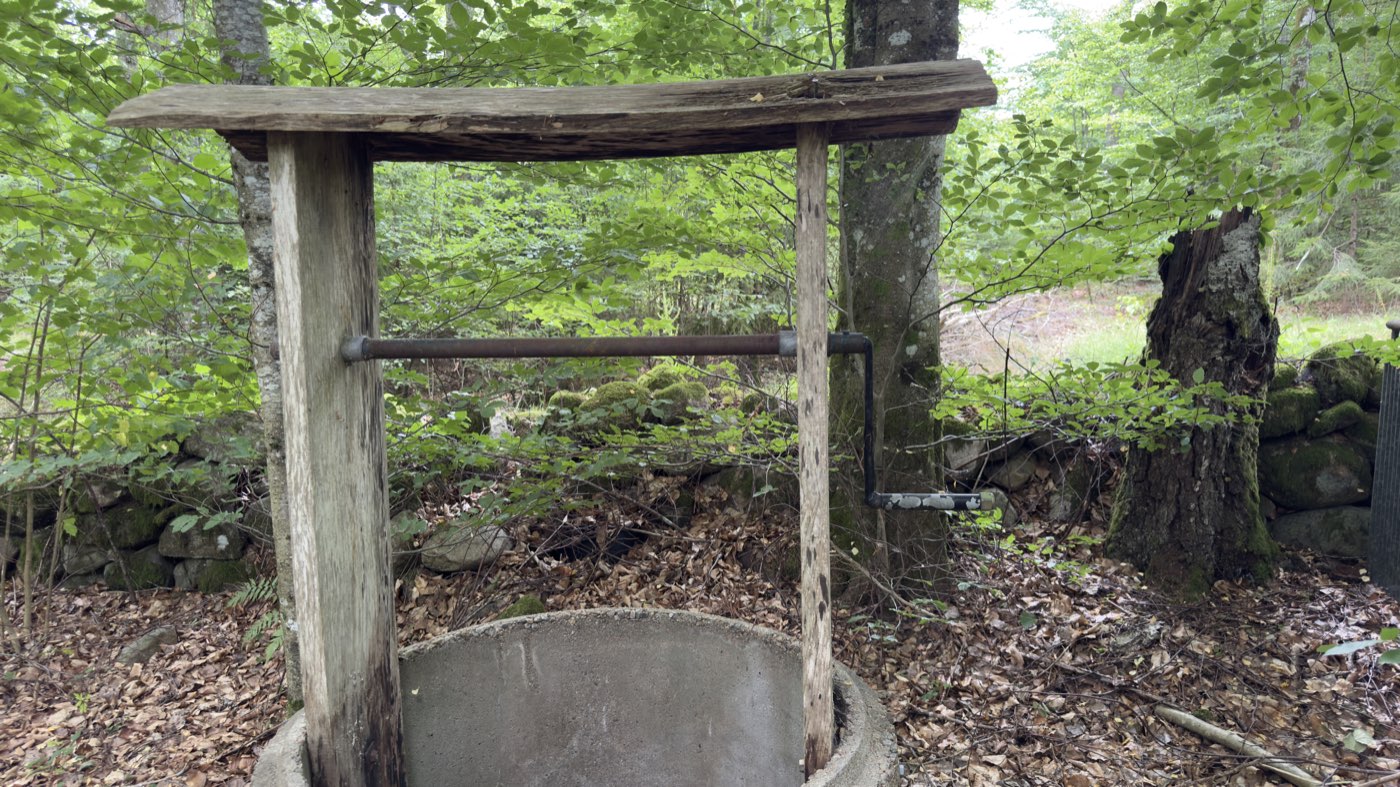
Walk on from the cross for a few minutes and you quickly notice that this forest was not always forest. Sixty metres away stands a well — a concrete ring, above it a frame of two posts, a crossbeam and an iron rod. Behind it a dry-stone wall runs through the trees.
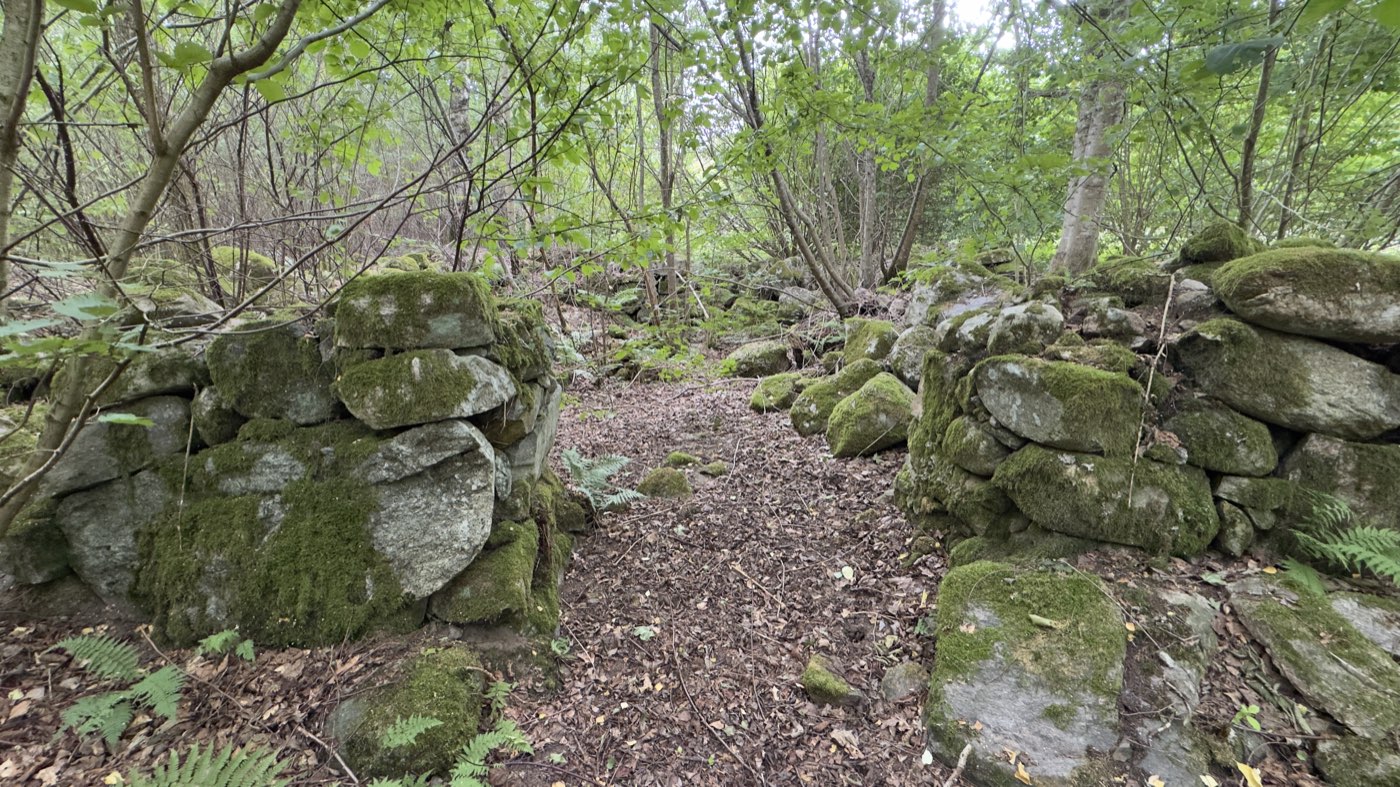
And finally a sunken lane, framed left and right by moss-green walls as tall as a person. Every one of those walls is handwork, stone by stone picked out of the fields. About six hundred metres from the cross lies an old farmstead site whose extent is still drawn on a map from 1705 and whose name appears in writing as early as 1626.
That is the context that finally explains the cross: in the 19th century these woods were open, worked land. Farms, tracks, pasture, walls. A child walking here was not walking through wilderness but through a neighbourhood. The forest only came back later and has covered everything — the walls, the well, the lane and the cross.
What remains
What occupies me most is the year 1973. By then Johanna had been dead for 117 years. Nobody was left alive who had known her. And yet somebody walked into the forest, took down the cross that had gone rotten and set a new one — with the same three letters and the same date.
Those people almost certainly no longer knew that she was called Johanna Nilsdotter, that she was born on 12 April 1852, that she was the daughter of the crofter Nils Olsson and of Sissa Trulsdotter. They only knew: something terrible happened to a child here, and this cross stays standing.
Now the name stands beside it again. Not in the wood — online, where it can be found. That is little. But it is more than "a young girl".
How I find places like this
Without a map I would never have seen this cross. There is no sign by the road, no trail, no hint. It is a point in a register almost nobody reads.
That is exactly what I use the PrimeMap app for: it shows memorial crosses, croft ruins, grave fields and archaeological sites as their own pins on the map — with the original description from the heritage register, translated into your language. You know beforehand what to expect, and you find places you would otherwise walk past. The rest — the parish books, the names, the story behind it — is down to your own curiosity.
That same evening I was out a few kilometres further north: there lie four places near Verum that are not what they seem — a mass grave from the snapphane era, carvings with the wrong age, and a walk-in root cellar from 1638. One of them commemorates a man who was also killed by a falling tree.
Find the stories on your doorstep
Over 680,000 archaeological sites, plus castles, ruins, memorial stones and forgotten places across Europe — with descriptions in your language. Free for iPhone & Android.

Sources: Riksantikvarieämbetet (Fornsök), site "Minnesmärke", Hästveda parish, Hässleholm municipality · Riksarkivet, Hästveda parish archive (SE/LLA/13174), death register CI:5 p. 183 no. 15 and baptism register · own photographs, 18 July 2026.